
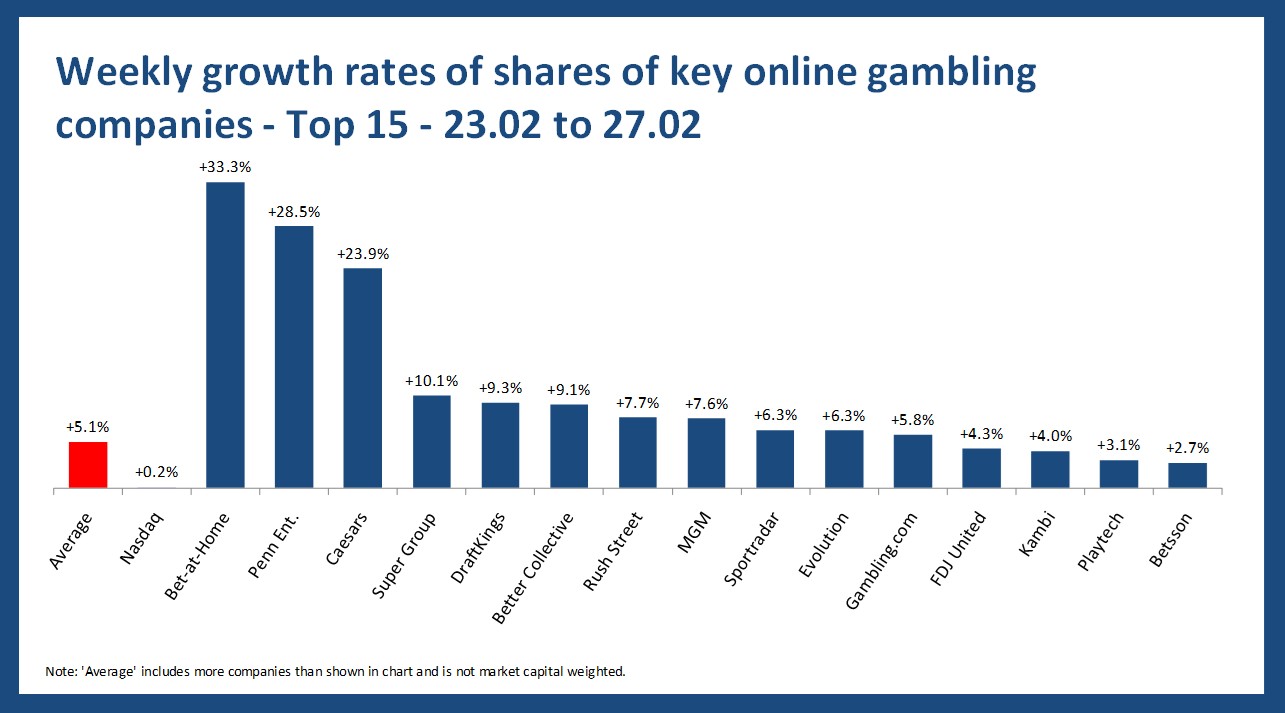
Online gambling stocks performance showed solid momentum last week, with the companies in our sample posting an average gain of 5%, clearly outperforming the flat Nasdaq Composite. Standout moves came from Bet-at-Home and Penn Entertainment, while Flutter and Raketech lagged behind with notable declines. Across segments, online-focused operators and multi-channel businesses led the way, while suppliers and affiliates delivered more modest gains overall.
Overview
- Average growth – On average, share prices analyzed increased by +5% in the last week.
- “Winner” – The most significant leap in our sample of online gambling-focused companies was taken by Bet-at-Home with an increase of +33%, followed by Penn (+29%).
- “Loser” – Flutter and Raketech had the worst weekly performance in our analysis, with a change of -11% and -8%.
- Comparison to the Nasdaq Composite – Compared to the development of the Nasdaq Composite (+0.2%), the average development of the online gambling industry looks “better”.
Segment-specific developments
- Online-focused operators – The shares of online-focused operators included in the analysis saw, on average, an increase of +6%; with Bet-at-Home (+33%) leading the ranking.
- Multi-channel operators – Among the multi-channel operators that also operate a relevant retail business, Penn is the “winner” with +29% while the average share development was +9%.
- Suppliers – The shares of the suppliers included in the analysis saw, on average, an increase of +3%. The winner is Sportradar with +6%.
- Affiliates – On average, affiliates’ shares saw an increase of +0.2% with Better Collective (+9%) leading and Raketech (-8%) coming last.
The share increase of Bet-at-Home
Last week’s share strength for Bet-at-Home appears to be linked to an ad-hoc corporate announcement on February 23 revealing a significant change in the company’s shareholder structure, where major stakeholders disclosed substantial voting rights holdings.
The decline of Flutter shares
Last week, Flutter’s shares weakened after the company reported quarterly results that missed revenue and earnings expectations and issued cautious guidance for 2026, which spooked investors and led to heavier selling pressure. The combination of slower-than-expected growth in key markets and analyst downgrades on growth prospects helped explain the stock’s negative performance from 23.02 to 27.02.
Please find more data and the methodology applied in the current edition of the OGQ Magazine. Also, find more content in our data section.
 powered by