
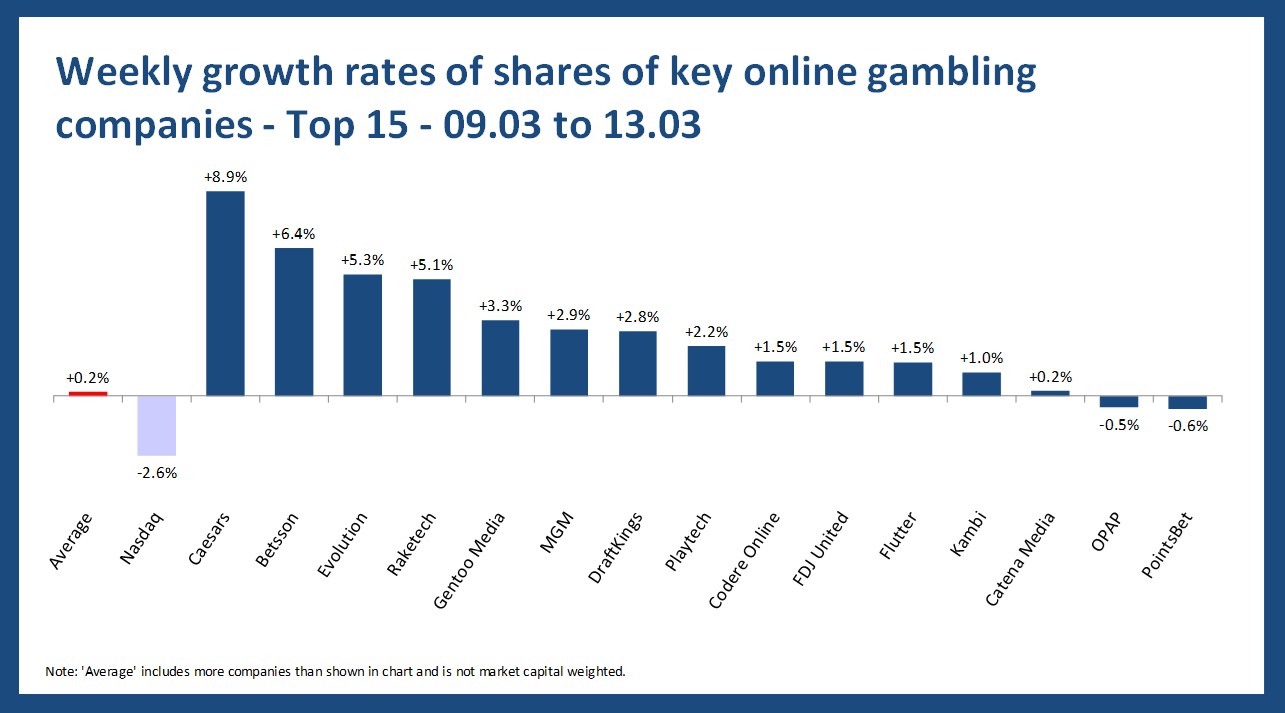
Online gambling stocks performance was broadly stable over the past week, with share prices in the analyzed group rising by an average of 0.2%, outperforming the Nasdaq Composite, which fell by 3%. Caesars delivered the strongest gain with a 9% jump, followed by Betsson at 6%, while Bet-at-Home and Jumbo Interactive recorded the sharpest declines. Across segments, results were mixed, with multi-channel operators posting modest gains on average, while suppliers and online-focused operators saw slight declines.
Overview
- Average growth – On average, share prices analyzed increased by +0.2% in the last week.
- “Winner” – The most significant leap in our sample of online gambling-focused companies was taken by Caesars with an increase of +9%, followed by Betsson (+6%).
- “Loser” – Bet-at-Home and Jumbo Interactive had the worst weekly performance in our analysis, with a change of -9% and -8%.
- Comparison to the Nasdaq Composite – Compared to the development of the Nasdaq Composite (-3%), the average development of the online gambling industry looks “better”.
Segment-specific developments
- Online-focused operators – The shares of online-focused operators included in the analysis saw, on average, a decrease of -0.2%; with Betsson (+6%) leading the ranking.
- Multi-channel operators – Among the multi-channel operators that also operate a relevant retail business, Caesars is the “winner” with +9% while the average share development was +0.5%.
- Suppliers – The shares of the suppliers included in the analysis saw, on average, a decrease of -0.4%. The winner is Evolution with +5%.
- Affiliates – On average, affiliates’ shares saw an increase of +1% with Raketech (+5%) leading and Better Collective (-2%) coming last.
The share increase of Caesars
The rise in Caesars’ share price during the week of 9–13 March was mainly driven by takeover news that caught investors’ attention. Reports on 11–12 March said that billionaire Tilman Fertitta was in exclusive talks to acquire Caesars Entertainment in a deal worth around USD 7 billion, potentially offering a premium to the market price. Such takeover speculation often lifts a company’s stock, as investors start pricing in the possibility of a higher valuation.
The decline of Bet-at-Home shares
The decline in Bet-at-Home’s share price between 9 and 13 March appears to be linked to renewed investor concerns after reports highlighting weaker-than-expected operating performance and soft recent figures compared with market expectations. Analysts noted that both revenue and profitability came in below forecasts, which weighed on sentiment and triggered selling pressure among investors. As a result, the stock came under pressure during the week as the market reassessed the company’s near-term growth outlook.
Please find more data and the methodology applied in the current edition of the OGQ Magazine. Also, find more content in our data section.
 powered by