
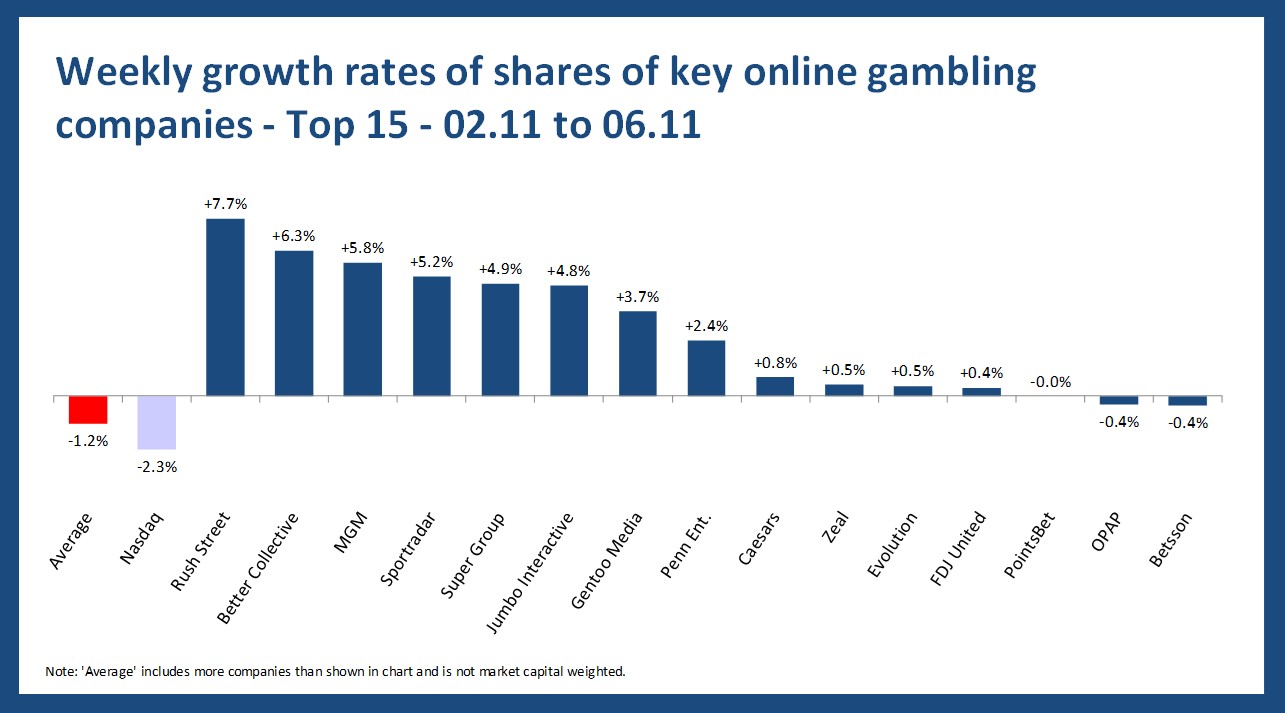
The online gambling stocks performance was slightly negative last week, with shares in our analysis falling by 1% on average, compared with a 2% decline for the Nasdaq Composite. Rush Street led the ranking with an 8% gain, while Grandstand recorded the weakest performance, falling 19%.
Overview
- Average growth – On average, share prices analyzed decreased by -1% in the last week.
- “Winner” – The most significant leap in our sample of online gambling-focused companies was taken by Rush Street with an increase of +8%, followed by Better Collective (+6%).
- “Loser” – Grandstand had the worst weekly performance in our analysis, with a change of -19%.
- Comparison to the Nasdaq Composite – Compared to the development of the Nasdaq Composite (-2%), the average development of the online gambling industry looks “better”.
Segment-specific developments
- Online-focused operators – The shares of online-focused operators included in the analysis saw, on average, a decrease of -0.8%; with Rush Street (+8%) leading the ranking.
- Multi-channel operators – Among the multi-channel operators that also operate a relevant retail business, MGM is the “winner” with +6% while the average share development was -0.2%.
- Suppliers – The shares of the suppliers included in the analysis saw, on average, a decrease of -2%. The winner is Sportradar with +5%.
- Affiliates – On average, affiliates’ shares saw a decrease of -3% with Better Collective (+6%) leading and Grandstand (-19%) coming last.
The share increase of Rush Street
Rush Street Interactive’s share price recovery may have been supported by director Thomas Winter’s purchase of 10,000 shares, disclosed on November 2. Investors may also have taken a fresh look at the company’s strong Q3 results, released on October 28, which showed revenue growth of 39% and a 73% increase in adjusted EBITDA, although no direct link to the week’s share price increase has been confirmed.
The decline of Grandstand shares
Grandstand, formerly Gambling.com Group, came under further pressure during the week of November 2–6, although no new company announcement was found to explain the decline. Investors may have remained concerned about its weaker marketing business and falling earnings ahead of the Q3 results scheduled for November 19, but a direct connection to the week’s sell-off cannot be confirmed.
Please find more data and the methodology applied in the current edition of the OGQ Magazine. Also, find more content in our data section.
 powered by